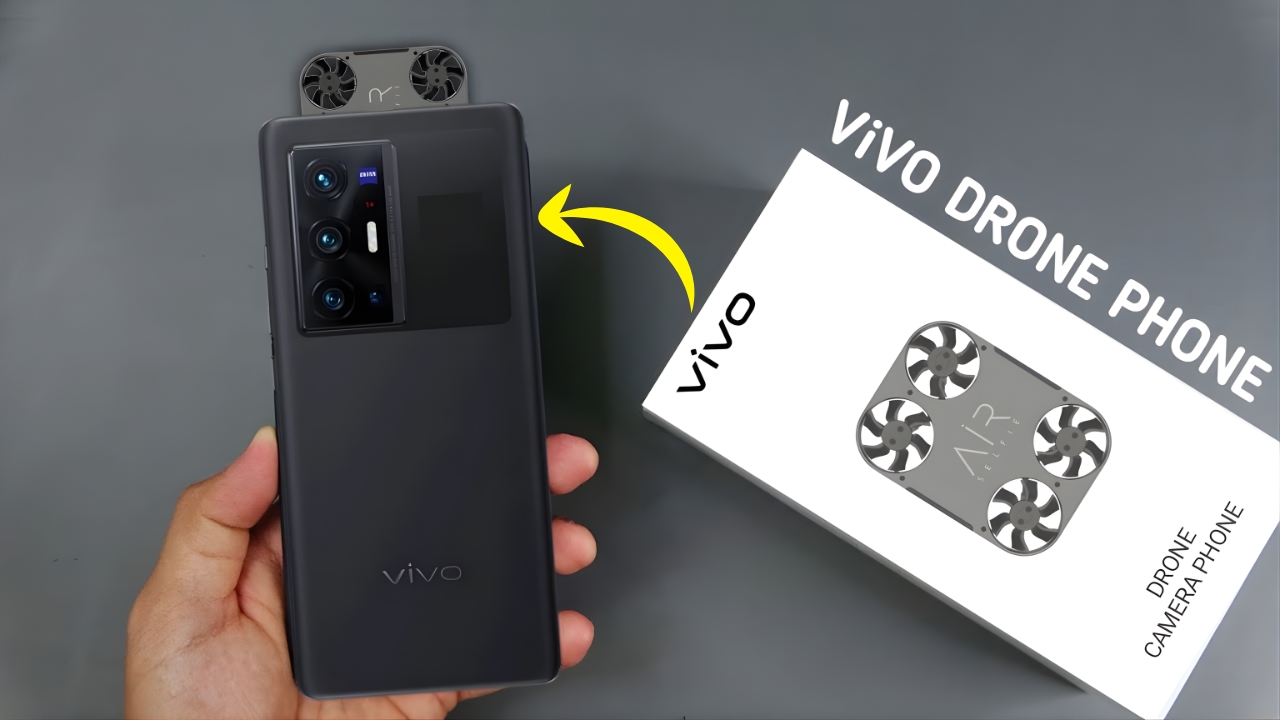
Vivo Drone Smartphone : Vivo just did what every other brand only dreamed about. In early 2026, the company quietly slipped a working drone inside a smartphone chassis and shipped it to customers.
This isn’t a concept render or a patent fantasy—it’s a genuine, flying camera that detaches from your phone, hovers above you, and captures angles that previously required a ₹80,000 DJI setup.
At roughly ₹1,45,000 for the base model, the Vivo Drone Phone costs less than buying a flagship smartphone and a decent drone separately.
That’s the genius here: Vivo didn’t just add a gimmick; they merged two product categories into one device that actually makes financial sense for content creators, travelers, and anyone who’s ever wished their phone could see the world from above.
The Mechanism: How a Drone Fits in Your Pocket
The engineering is genuinely clever. A motorized compartment slides open from the top edge of the phone, revealing a compact quadcopter module no bigger than a matchbox.
Four micro-propellers unfold automatically, the 200MP camera gimbal locks into position, and within seconds, you’ve got a personal aerial cameraman ready to fly.
The drone weighs just 85 grams, light enough that it doesn’t make the phone feel like a brick when docked.
In flight, it reaches altitudes up to 50 meters and maintains stable hovering using three infrared proximity sensors and AI-powered obstacle avoidance.
Fly near a tree branch or a wall, and the drone automatically adjusts course—no crashes, no panic, just smooth autonomous navigation.
Also Read: Why $730,000 Isn’t Enough : Super Target Slammed – Real Retirement Numbers & What You Need Instead
Control happens entirely through the phone’s 6.95-inch Dynamic AMOLED display. A dedicated flight interface shows real-time FPV (first-person view) footage from the drone’s camera, with touch controls for direction, altitude, and automated flight modes.
Gesture controls let you launch and land with a simple hand motion, while Follow Me mode keeps you centered in frame as you move.
Camera System: 200MP From the Sky
The flying module houses a 200MP main sensor capable of 8K video recording at 30fps.
This isn’t your typical drone camera—it’s a genuine smartphone-grade sensor with pixel binning, optical image stabilization, and computational photography baked in.
The result? Aerial shots with DSLR-level detail, dynamic range that handles harsh sunlight, and night modes that pull detail from near-darkness.
The phone itself carries a triple rear camera setup: a 50MP main sensor with OIS, a 32MP periscope telephoto with 5x optical zoom, and a 16MP ultrawide.
There’s no traditional front camera—the drone doubles as your selfie shooter, hovering at eye level for group shots that fit everyone in frame.
Also Read: New Adult Passport Rules in Australia 2026: What Applicants Must Know
It’s awkward at first, then genuinely liberating once you realize you’re no longer stuck with arm’s-length selfies.
Cinematic modes include Orbit (the drone circles you), Reveal (it ascends while tilting down), and Tracking (it follows you autonomously).
These aren’t software simulations—they’re actual flight paths the drone executes with meter-level precision.
Battery and Performance: Powering Two Devices
Vivo solved the obvious power problem with a split-cell architecture.
The main phone packs a 5,000 mAh battery with 150W fast charging, while the drone has its own dedicated 1,200 mAh cell that charges wirelessly when docked.
A full drone charge takes about 15 minutes and provides up to 22 minutes of flight time—competitive with standalone mini-drones.
The Snapdragon 8 Gen 4 processor handles everything from heavy gaming to real-time flight telemetry without breaking a sweat.
The 4nm chip’s AI engine processes obstacle avoidance data at 60fps, ensuring the drone reacts to hazards before they become problems.
Pair this with 16GB of RAM and 512GB of storage, and you’ve got a device that’ll stay relevant for years.
Vivo Drone Smartphone Who Should Actually Buy This
The Vivo Drone Phone makes sense for specific buyers. Travel vloggers who currently carry separate phones and drones, real estate agents needing aerial property shots, or adventure enthusiasts documenting hikes and bike rides will find immediate value.
It’s also compelling for content creators tired of lugging around gimbal setups—the drone replaces all of that with something that fits in your jacket pocket.
Casual users might struggle to justify the ₹1,45,000 price tag when a ₹50,000 phone and a ₹40,000 Mini SE drone offer similar capabilities separately. But that misses the point: this is about convenience, not just cost.
Also Read This : OnePlus Nord 5 Smooth performance smartphone in market, 6800mAh battery
Having a drone that’s always with you, always charged, and always ready to fly changes how you capture moments.
For India’s booming creator economy, the Vivo Drone Phone represents something genuinely new: a tool that expands what’s possible without demanding you become a licensed drone pilot or carry extra gear.
It’s not perfect—flight time could be longer, and the learning curve is real—but it’s a first step into a future where phones don’t just capture the world in front of them, but the world above, around, and beyond.
Vivo didn’t just iterate. They reinvented. And whether this becomes a niche curiosity or a category-defining moment depends entirely on whether buyers are ready to trust their phone with actual flight.